

Introduction
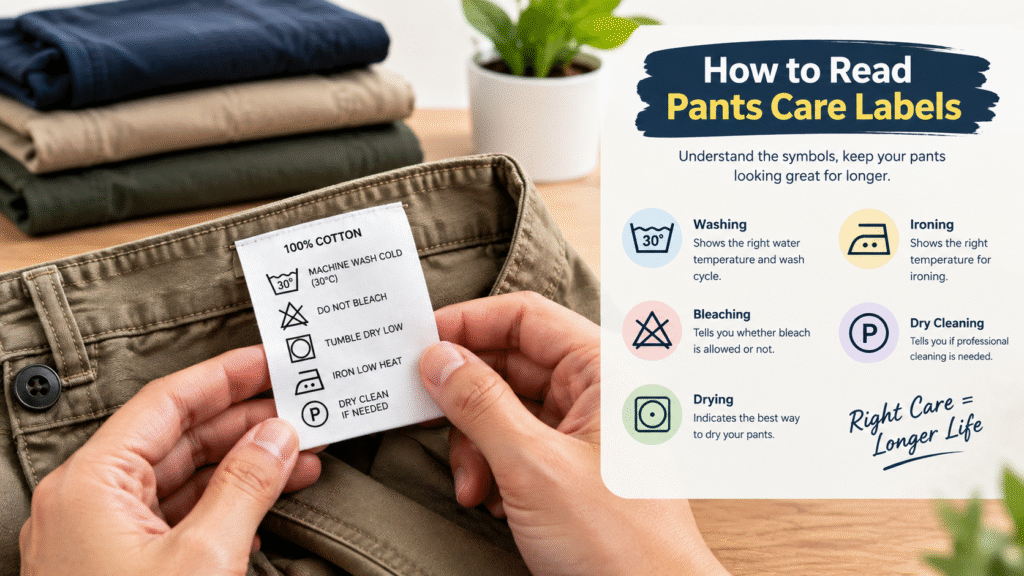
That small tag stitched inside the waistband of your pants isn’t just there for size and fabric content — it’s actually a set of instructions telling you exactly how to wash, dry, and press your pants without ruining them. The problem is, most of us never learned how to read pants care labels, so we either ignore the symbols entirely or guess and hope for the best. Understanding how to read pants care labels takes just a few minutes to learn, and once you do, you’ll avoid shrinking your favorite chinos, fading your dress trousers, or melting a wrinkle-resistant blend with too much iron heat.
This breakdown covers each symbol commonly found on pants, explains what it means, and shows how to apply it to the specific fabrics pants are typically made from. from — cotton, wool, polyester, and blends.
Table of Contents
Why Pants Care Labels Matter More Than You Think
Pants go through more stress than most garments — sitting, stretching, washing, and ironing all take a toll. A care label is essentially a manufacturer’s shortcut for telling you the safest way to keep the fabric, fit, and color intact. Skipping it is one of the most common reasons pants shrink, lose their shape, or develop shiny, damaged patches from incorrect ironing.
Care labels are typically arranged in the same order on every garment: washing, bleaching, drying, ironing, and dry cleaning. Once you recognize the five basic symbol groups, reading any label — on pants or otherwise — becomes second nature.
1. Washing Symbols
This icon typically appears as a small basin or tub holding water.
- Number of dots inside the tub: Indicates water temperature. One dot means cold water, more dots mean progressively warmer water is safe.
- A hand inside the tub: Means hand wash only — skip the machine entirely.
- Lines underneath the tub: One line means a gentle/permanent press cycle; two lines mean a delicate cycle. No lines means a normal cycle is fine.
- An “X” over the tub: Do not wash — this fabric requires dry cleaning only.
For everyday cotton or blended pants, you’ll usually see a tub with one or two dots, meaning cold or lukewarm water is safest. This matters because hot water is one of the leading causes of shrinkage in cotton pants specifically.
2. Bleaching Symbols
The bleaching symbol is a triangle.
- Plain triangle: Any bleach is safe to use.
- Triangle with two diagonal lines: Only non-chlorine, oxygen-based bleach is safe.
- Triangle with an “X” through it: No bleach of any kind — chlorine bleach in particular can weaken fibers and cause discoloration.
Most colored and printed pants will show the crossed-out triangle, since bleach tends to strip dye and weaken fabric structure over time.
3. Drying Symbols
You’ll recognize this one as a square, occasionally containing a circle to represent a tumble dryer.
- A circle inside the square: Safe for the tumble dryer. The dots placed inside the circle signal heat intensity — a single dot points to low heat, while additional dots mean higher heat.
- An “X” over the circle: Do not tumble dry; air dry instead.
- A square with a horizontal line: Dry flat.
- A square with a curved line at the top: Line dry (hang to dry).
- A square with diagonal lines in the corner: Dry in the shade, away from direct sunlight — common for darker colors that fade easily.
Dryer heat is a major factor in how long pants keep their shape, especially around the waistband and hems, so this symbol is worth checking every time.
4. Ironing Symbols
You’ll spot this symbol as a plain iron shape.
- Dots inside the iron: Indicate safe heat level. One dot means low heat (synthetics like polyester and nylon), two dots means medium heat (wool, polyester blends), and three dots means high heat (cotton and linen can typically handle this).
- An “X” over the iron: Do not iron at all — common for pants with plastic embellishments, sequins, or heat-sensitive synthetic fibers.
- Lines underneath the iron symbol: Indicate whether steam is allowed; a crossed-out steam cloud means no steam should be used.
This is one of the most important symbols to check before pressing pants, since using too much heat on synthetic blends can cause permanent shine, melting, or fabric distortion. If you’re dealing with wrinkled cotton pants specifically, our guide on how to remove wrinkles from cotton pants walks through safe ironing and steaming techniques in more detail.
5. Dry Cleaning Symbols
The dry cleaning symbol is a circle.
- Empty circle: Dry clean only.
- Circle with a letter inside (A, P, or F): Tells professional cleaners which solvent to use — this is mainly relevant to the dry cleaner, not you.
- Circle with an “X”:** Skip dry cleaning altogether for this item.
- Circle with a bar underneath: A gentler dry cleaning cycle is required.
Wool dress pants and some structured formal trousers commonly carry this symbol, since dry cleaning helps preserve their shape and tailoring far better than home washing would.
Quick Reference by Fabric
Since pants come in a range of materials, here’s a fast cheat sheet for what to expect based on fabric type:
- Cotton pants: Usually machine washable in cold or warm water, tumble dry on low, and can tolerate higher iron heat. Learn more in our guide on how to maintain the quality of pants.
- Wool and wool-blend pants: Often dry clean only, with low-heat ironing and no tumble drying. See our full comparison of wool vs. cotton pants for care differences between the two.
- Polyester and synthetic blends: Typically machine washable on a gentle cycle with low heat for both drying and ironing, since high heat can melt or warp synthetic fibers. Our breakdown of polyester pants vs. cotton pants covers how each fabric holds up over time.
Common Mistakes People Make with Care Labels
- Assuming all pants of the same color wash the same way. Fabric blend matters more than color when it comes to safe washing temperatures.
- Ignoring the “line dry” symbol and using a dryer anyway. This is a common cause of shrinkage in cotton and cotton-blend pants.
- Ironing over zippers, buttons, or plastic trims at high heat. Even if the fabric can handle high heat, hardware often can’t.
- Cutting out the care label because it’s itchy. Take a photo of it first, or transfer the key details to a note, so you don’t lose the washing and drying instructions later.
FAQs
What do the numbers or dots on care label symbols mean?
Dots typically indicate intensity level — more dots mean higher heat or a stronger setting, whether it’s for washing, drying, or ironing.
Can I wash pants that only have a dry clean symbol?
It’s risky. Dry clean-only labels usually apply to fabrics like wool or delicate blends that can shrink, lose shape, or become misshapen in water. If you must wash at home, use a gentle hand-wash cycle and cold water, and understand you’re taking a risk with the garment’s structure.
Why do care labels matter more for pants than other clothing?
Pants experience more friction, stretching, and washing frequency than many other garments, so following the label helps prevent shrinkage, fading, and loss of shape around high-stress areas like the waistband, knees, and seat.
Where is the care label usually located on pants?
Most commonly it’s sewn into the inside waistband, though some brands place it along an inner side seam.
Final Thoughts
Learning how to read pants care labels isn’t complicated once you know the five basic symbol categories — washing, bleaching, drying, ironing, and dry cleaning. Taking thirty seconds to check the label before you wash or press a new pair of pants can save you from shrinkage, fading, or fabric damage that shortens the life of your wardrobe. Pair this knowledge with good day-to-day habits, and your pants will stay in better shape for a lot longer.
Best products of How to Read Pants Care Labels
1. Avery No-Iron Fabric Labels (54-Pack)
Perfect for anyone who wants to keep track of clothing after washing and drying. These peel-and-stick fabric labels require no ironing or sewing — just handwrite with a permanent marker, apply, and they’re built to survive repeated washer and dryer cycles without peeling.
2. Personalized Clothing Labels for Nursing Home Use
A practical add-on for households or care settings where clothes get mixed up in shared laundry. Each label is custom-printed with a name, sticks directly onto the garment or care label, and holds up through frequent washing — no ironing or sewing required.