
Introduction
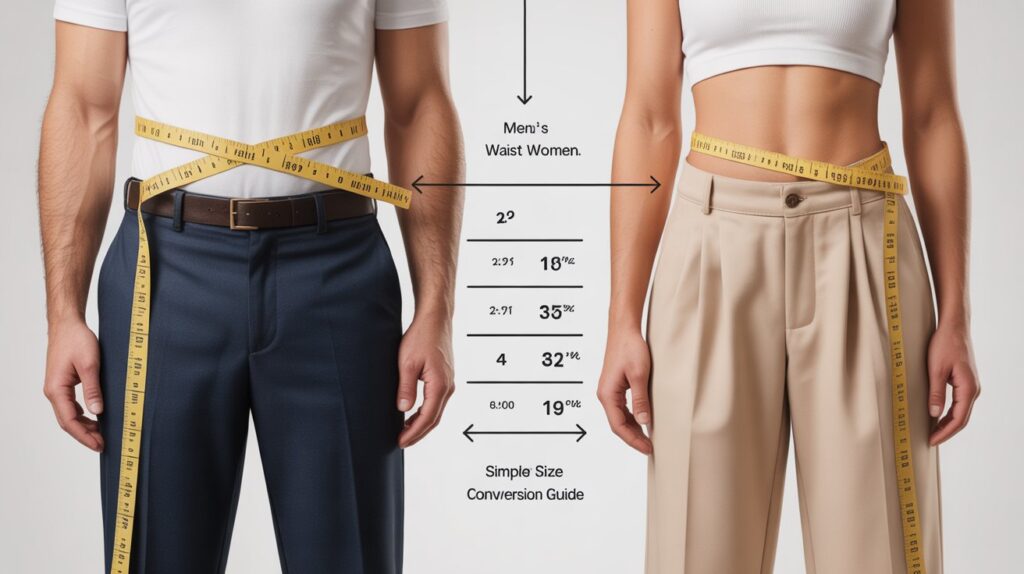
A pants size conversion guide men vs women is essential for anyone who shops for clothing online or switches between men’s and women’s pants. Since both sizing systems are based on different standards, it often becomes confusing to find the right fit. Men’s pants use waist measurements in inches, while women’s pants follow numeric sizing that varies by brand. This guide will help you understand the differences, learn easy conversion methods, and choose the correct size with confidence.
Table of Contents
Understanding Pants Sizing Systems
Understanding how pants sizes work is the first step in using a pants size conversion guide men vs women effectively. Men’s and women’s pants are sized differently, which often creates confusion when shopping online or trying to convert sizes between categories. Knowing how each sizing system works makes it easier to find the right fit and avoid ordering the wrong size.
Men’s Pants Sizing
Men’s pants sizes are usually based on two measurements: waist size and inseam length. These sizes are shown in a format like 32×30.
- The first number represents the waist measurement in inches.
- The second number represents the inseam length, which is the measurement from the crotch to the bottom of the leg.
For example, a size 32×30 means:
- 32 inches waist
- 30 inches inseam
This system is simple and based on actual body measurements, which makes men’s sizing more straightforward. Because of this, many people find it easier to use men’s measurements as a reference in a pants size conversion guide men vs women.
Another important detail is that men’s pants often come in different fits, such as:
- Slim fit – narrower through the legs
- Regular fit – balanced and comfortable
- Relaxed fit – roomier in the seat and thighs
Even when the waist size is the same, the fit can change how the pants feel.
Women’s Pants Sizing
Women’s pants sizing is more complex because it often uses numeric sizes instead of direct waist measurements. Common women’s sizes include:
0, 2, 4, 6, 8, 10, 12, 14, and so on.
Unlike men’s sizing, these numbers do not directly match waist measurements in inches. For example:
- A women’s size 8 may fit a 29-inch waist
- A women’s size 12 may fit a 31-inch waist
However, these measurements can vary between brands, which is why a pants size conversion guide men vs women is so helpful when comparing sizes.
Women’s pants are also designed with body shape in mind, especially the waist-to-hip ratio. This means:
- The waist is often narrower
- The hips have more room
- The rise may be higher or lower depending on style
This design difference is one reason why converting from men’s to women’s pants sizes is not always exact.
Letter Sizes in Women’s Pants
In addition to number sizes, women’s pants may also be labeled with letter sizes, such as:
- XS
- S
- M
- L
- XL
These letter sizes correspond to a range of numeric sizes. For example:
- Small (S) = sizes 4–6
- Medium (M) = sizes 8–10
- Large (L) = sizes 12–14
Because these ranges vary by brand, checking the brand’s size chart is always recommended.
Why Size Conversion Matters
The difference between men’s and women’s sizing systems is the main reason why shoppers need a reliable pants size conversion guide men vs women. Men’s sizes are measurement-based, while women’s sizes are brand-based and shape-based.
For example:
- A men’s 30 waist may convert to a women’s size 10
- A men’s 32 waist may convert to a women’s size 12 or 14
These conversions are helpful, but they are only estimates because fit, cut, and fabric can affect the final result.
The Importance of Measurements
No matter what the label says, body measurements are the most accurate way to choose pants sizes. Measuring your:
- Waist
- Hips
- Inseam
can help you compare your measurements with brand size charts and use a pants size conversion guide men vs women more accurately.
This is especially important because:
- Brands may size differently
- Stretch fabrics fit differently than rigid fabrics
- Slim and relaxed fits change the overall feel
Understanding these basics helps shoppers make better choices and improves the accuracy of size conversion between men’s and women’s pants.
Men vs Women Pants Size Conversion Chart
A pants size conversion guide men vs women becomes much easier to use when you have a clear and simple conversion chart. Since men’s and women’s sizing systems are based on different methods, a chart helps you quickly match equivalent sizes without confusion.
Men’s pants are measured in waist inches, while women’s pants use numeric sizes. The chart below shows approximate conversions to help you find the closest match.
Men to Women Pants Size Conversion Chart
| Men’s Waist (Inches) | Women’s Size |
| 28 | 6 |
| 29 | 8 |
| 30 | 10 |
| 31 | 12 |
| 32 | 14 |
| 33 | 16 |
| 34 | 18 |
| 36 | 20 |
| 38 | 22 |
| 40 | 24 |
👉 For example:
- A men’s size 32 usually converts to a women’s size 14
- A men’s size 30 عادة fits like a women’s size 10
Women to Men Pants Size Conversion Chart
| Women’s Size | Men’s Waist (Inches) |
| 6 | 28 |
| 8 | 29 |
| 10 | 30 |
| 12 | 31 |
| 14 | 32 |
| 16 | 33 |
| 18 | 34 |
| 20 | 36 |
For example:
- A women’s size 12 converts to a men’s 31 waist
- A women’s size 16 is close to a men’s 33 waist
How to Use This Conversion Chart
This pants size conversion guide men vs women should be used as a reference, not an exact rule. Here’s how to use it correctly:
- Start with your actual waist measurement
- Find the closest match in the chart
- Adjust based on fit (slim, regular, relaxed)
Why Conversion Is Not Always Exact
Even with a chart, sizes may not match perfectly because:
- Women’s pants are designed for curves (more room in hips)
- Men’s pants have a straighter cut
- Different brands use different sizing standards
- Fabric type (stretch vs non-stretch) affects fit
Because of these factors, a pants size conversion guide men vs women gives an estimate, not a guaranteed fit.
Quick Conversion Tip
A commonly used shortcut is:
- Add 21 to men’s waist size → women’s size
- Subtract 21 from women’s size → men’s waist
Example:
- Men’s 31 → Women’s 12
- Women’s 14 → Men’s 32
This quick method works well when you don’t have a chart available.
Final Note
Using a conversion chart saves time and reduces guesswork, especially when shopping online or trying a different clothing category. However, for the best results, always combine this pants size conversion guide men vs women with your actual body measurements and the brand’s size chart.
Simple Conversion Formula
When you don’t have a chart available, a quick formula can make a pants size conversion guide men vs women much easier to use. This simple method helps you estimate the equivalent size between men’s and women’s pants within seconds.
Basic Conversion Rule
The most commonly used formula is:
- Men to Women:
➤ Add 21 to the men’s waist size - Women to Men:
➤ Subtract 21 from the women’s size
This rule works because women’s numeric sizes are generally based on a scale that differs from men’s waist measurements by about 21 units.
Examples for Better Understanding
Using this pants size conversion guide men vs women, here are some easy examples:
➤ Men to Women Conversion
- Men’s 30 waist → 30 + 21 = Women’s 10
- Men’s 32 waist → 32 + 21 = Women’s 14
- Men’s 34 waist → 34 + 21 = Women’s 18
➤ Women to Men Conversion
- Women’s 12 → 12 − 21 = Men’s 31 waist
- Women’s 14 → 14 − 21 = Men’s 32 waist
- Women’s 16 → 16 − 21 = Men’s 33 waist
These examples show how quickly you can estimate sizes without needing a full chart.
Why This Formula Works
The formula is based on general sizing patterns used in the fashion industry:
- Men’s sizes are based on actual waist measurements (in inches)
- Women’s sizes are based on a number scale that reflects body proportions
The difference between these systems averages around 21 units, which is why this formula is widely used in any pants size conversion guide men vs women.
Important Limitations
While this formula is simple and useful, it is not always 100% accurate. Here’s why:
- Different brands may size differently
- Women’s pants vary based on hip measurements
- Fit types (slim, regular, relaxed) can change sizing
- Stretch fabrics may fit differently than rigid materials
Because of these factors, the formula should be used as a quick estimate, not a perfect conversion.
When to Use This Formula
This pants size conversion guide men vs women formula is especially helpful when:
- You are shopping online without a size chart
- You need a fast size estimate
- You are comparing sizes across categories
However, for the best results, always combine this formula with your actual body measurements and the brand’s size guide.
Final Tip
Think of the formula as a starting point. It gives you a close idea of your size, but adjusting for fit, fabric, and body shape will always give you the best outcome.
Using this simple method correctly can save time, reduce confusion, and make size conversion between men’s and women’s pants much easier.
Key Differences in Fit (Very Important)
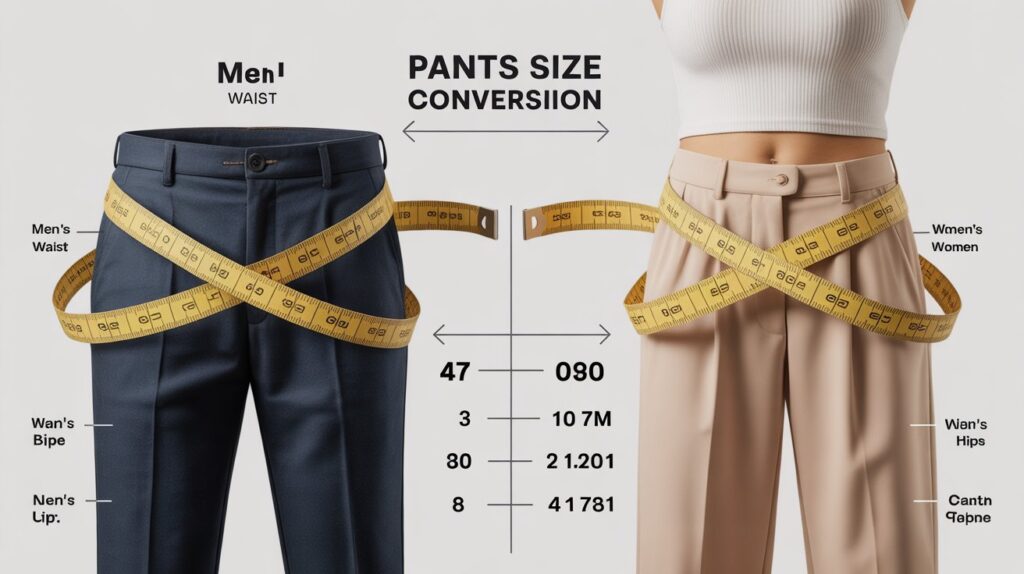
Even when sizes match using a pants size conversion guide men vs women, the overall fit can feel very different. This is because men’s and women’s pants are designed for different body shapes and proportions. Understanding these differences is essential if you want comfort, proper fit, and a better shopping experience.
1. Waist vs Hip Ratio
The biggest difference between men’s and women’s pants is how they handle the waist and hips.
- Women’s pants
- Designed with a smaller waist and wider hips
- Follow natural body curves
- Provide more room in the hip and thigh area
- Men’s pants
- Have a more straight cut from waist to hips
- Less difference between waist and hip measurements
- Fit more uniformly around the lower body
This means that even if you use a pants size conversion guide men vs women, the waist might fit but the hips could feel tight or loose.
2. Rise (Distance from Crotch to Waist)
The rise affects where the pants sit on your body.
- Women’s pants
- Available in high-rise, mid-rise, and low-rise
- Often sit higher on the waist
- Designed for styling and body shaping
- Men’s pants
- Usually mid-rise or slightly low-rise
- Sit more naturally around the hips
- Focus more on comfort than styling variation
Because of this, converted sizes may sit differently on your body even if the waist measurement is correct.
3. Leg Shape and Cut
The shape of the legs is another key difference.
- Women’s pants
- More variety: skinny, straight, bootcut, flare
- Often taper to highlight body shape
- Can be tighter around thighs and calves
- Men’s pants
- Common fits: slim, regular, relaxed
- Generally straighter from thigh to ankle
- Less emphasis on contouring
When using a pants size conversion guide men vs women, the leg fit can feel very different even if the waist size matches.
4. Length and Inseam
- Men’s pants
- Come with specific inseam lengths (e.g., 30, 32, 34)
- Easier to choose exact leg length
- Women’s pants
- Often use standard lengths (short, regular, tall)
- Inseam may not be clearly labeled
This difference can affect how pants look and fit after conversion.
5. Fabric and Stretch
Fabric plays a big role in how pants fit:
- Women’s pants
- Often include stretch materials (like elastane)
- More flexible and body-hugging
- Men’s pants
- Usually made from stiffer fabrics (like denim or cotton)
- Less stretch, more structured
Because of this, a size from a pants size conversion guide men vs women may feel tighter or looser depending on the fabric.
Design Purpose
- Women’s pants
- Focus on style, shape, and curves
- Designed to enhance body silhouette
- Men’s pants
- Focus on comfort, durability, and practicality
- Designed for a straight and relaxed look
Why This Matters
Using a pants size conversion guide men vs women gives you the right size range, but it does not guarantee a perfect fit. That’s because:
- Body shapes are different
- Cuts and styles vary
- Brands use different design standards
Final Tip
Always treat size conversion as a starting point, not a final answer. For the best fit:
- Check waist and hip measurements
- Consider the type of fit (slim, relaxed, etc.)
- Pay attention to fabric and stretch
Understanding these key differences will help you use any pants size conversion guide men vs women more accurately and choose pants that truly fit well and feel comfortable.
How to Measure Yourself Correctly
Accurate measurements are the foundation of any pants size conversion guide men vs women. Without knowing your true body measurements, even the best conversion chart or formula can give the wrong result. Taking a few minutes to measure yourself properly can save time, money, and frustration when buying pants.
What You Need
Before you start, gather these simple tools:
- A soft measuring tape
- A mirror (to check positioning)
- A notebook or phone to record measurements
Tip: Measure over light clothing or directly on your body for the most accurate results.
1. How to Measure Your Waist
The waist measurement is the most important part of a pants size conversion guide men vs women.
Steps:
- Stand straight and relaxed
- Locate your natural waistline (just above your belly button)
- Wrap the measuring tape around your waist
- Keep it snug but not tight
- Make sure the tape is level all around
Do not suck in your stomach—this can lead to incorrect sizing.
2. How to Measure Your Hips
Hip measurement is especially important when converting between men’s and women’s sizes.
Steps:
- Stand with your feet together
- Wrap the measuring tape around the widest area of your hips.
- Keep the tape straight and parallel to the ground
- Ensure it is comfortable, not tight
This measurement helps ensure the pants will fit properly around the lower body.
3. How to Measure Your Inseam
The inseam determines the length of the pants.
Steps:
- Stand straight with legs slightly apart
- Measure from the crotch down to the ankle
- You can also measure a pair of pants that fits you well
- This is especially useful for men’s pants, which include inseam in sizing.
4. Why These Measurements Matter
A pants size conversion guide men vs women is based on general size differences, but your actual body measurements are more reliable.
Here’s why:
- Brands may use different size standards
- Women’s sizes vary more than men’s
- Fit types (slim, regular, relaxed) affect sizing
- Fabric stretch can change how pants feel
Measurements help you match your body to the correct size, not just the label.
5. Common Measuring Mistakes to Avoid
To get accurate results, avoid these mistakes:
- Measuring over thick clothing
- Pulling the tape too tight or leaving it too loose
- Measuring at the wrong waist position
- Not keeping the tape straight
6. Pro Tips for Better Accuracy
- Measure yourself twice to confirm results
- Use a mirror to check tape alignment
- Ask someone for help if possible
- Round to the nearest whole number for easy conversion
Final Tip
Using correct measurements makes any pants size conversion guide men vs women far more accurate. Instead of guessing your size, you’ll have reliable numbers to compare with charts and formulas.
Tips for Switching Between Men’s and Women’s Pants
Switching between men’s and women’s pants can be useful for style, comfort, or availability. However, even with a pants size conversion guide men vs women, the fit will not be exactly the same. This is because both categories are designed differently. The tips below will help you choose the right size and avoid common fitting issues.
1. Start with Accurate Measurements
Before using any pants size conversion guide men vs women, make sure you know your:
- Waist size
- Hip measurement
- Inseam length
These measurements are more reliable than size labels and help you choose the closest fit.
2. Use Conversion as a Starting Point Only
Conversion charts and formulas give an estimate, not a perfect match.
- A converted size may fit in the waist but not in the hips
- Different brands may size differently
Always treat the conversion as a guide, then adjust based on fit and comfort.
3. Tips for Women Buying Men’s Pants
Women often choose men’s pants for a relaxed or straight fit. Here’s how to get the best result:
- Consider going one size smaller for a better waist fit
- Check the inseam length, as men’s pants may be longer
- Choose slim or tapered fits if you prefer a closer shape
- Be aware that hip space may feel tighter due to the straight cut
4. Tips for Men Buying Women’s Pants
Men may try women’s pants for style or better stretch. Keep these points in mind:
- Focus on hip fit first, as women’s pants allow more room in this area
- Be prepared for a higher rise (pants may sit above the waist)
- Check fabric—many women’s pants include stretch for comfort
- Consider sizing up if the fit feels tight around the thighs
5. Pay Attention to Fabric and Stretch
Fabric plays a big role when switching categories:
- Stretch fabrics (like elastane blends) are more forgiving
- Non-stretch fabrics require more accurate sizing
A size from a pants size conversion guide men vs women may feel different depending on the material.
6. Choose the Right Fit Style
Fit type can change how pants feel, even in the same size.
- For a tighter look → choose slim fit
- For everyday comfort → choose regular fit
- For more room → choose relaxed fit
Selecting the right fit helps balance the differences between men’s and women’s designs.
7. Always Check Brand Size Charts
Each brand may follow its own sizing system. Before buying:
- Compare your measurements with the brand’s chart
- Read product descriptions for fit details
- Check customer reviews if available
This step improves accuracy when using a pants size conversion guide men vs women.
8. Try Before You Buy (If Possible)
If you are shopping in-store:
- Try multiple sizes and fits
- Move around to check comfort (sit, walk, bend)
- Check how the pants feel at the waist, hips, and thighs
Fit is not just about size—it’s also about comfort and movement.
Final Tip
Switching between men’s and women’s pants is completely possible, but it requires a little adjustment. A pants size conversion guide men vs women gives you the right starting point, while your measurements, fit preference, and fabric choice help you find the perfect final fit.
International Size Differences
When using a pants size conversion guide men vs women, it is important to understand that sizing is not the same across all countries. International brands follow different measurement systems, which can make pants sizing confusing when shopping globally or online.
Knowing these differences helps you avoid mistakes and choose the correct size more confidently.
1. US, UK, and EU Sizing Systems
Different regions use different sizing methods:
🇺🇸 United States (US)
- Men’s sizes are based on waist in inches (e.g., 30, 32, 34)
- Women’s sizes use numbers (0, 2, 4, 6, 8, etc.)
🇬🇧 United Kingdom (UK)
- Women’s sizing in the UK system is typically about two numbers larger than the equivalent US size.
- Example: US 8 = UK 12
- Men’s sizing is similar to US in waist inches
🇪🇺 Europe (EU)
- Uses a numeric system based on body measurements in centimeters
- Example: Men’s 32 waist ≈ EU 48–50
- Women’s sizes are often 34, 36, 38, etc.
This is why a pants size conversion guide men vs women is essential when buying from international brands.
2. Why Sizes Change Between Countries
Sizing differences exist because:
- Each region uses its own measurement standards
- Body shape averages differ slightly by region
- Fashion brands adjust sizing based on their target market
- Some brands prioritize fit style over exact measurement
This means a size 32 in one country may not feel the same in another.
3. Men’s vs Women’s International Differences
Even internationally, the difference between men’s and women’s pants remains the same:
- Men’s pants → based on waist measurement (inches or cm)
- Women’s pants → based on numeric or coded sizing systems
However, the actual fit may vary more due to regional cuts and design preferences.
4. Example Conversions Across Regions
Using a pants size conversion guide men vs women, here are general international comparisons:
- Men’s 32 (US) ≈ EU 48–50 ≈ Women’s 14 (US)
- Men’s 30 (US) ≈ EU 46–48 ≈ Women’s 10 (US)
- Women’s 12 (US) ≈ EU 40–42 ≈ Men’s 31 waist
These are approximate values and can vary by brand.
5. Asian Sizing Difference
Asian sizing (Japan, Korea, China) often runs smaller:
- Sizes may be 1–2 levels smaller than US or EU sizes
- Example: US Medium may equal Asian Large or XL
- Pants are often designed for slimmer body frames
Always check size charts carefully when using a pants size conversion guide men vs women for Asian brands.
6. Why You Should Always Check Brand Charts
Even with international standards:
- Each brand may adjust sizing slightly
- Fit styles vary (slim, regular, oversized)
- Fabric stretch affects final fit
Never rely only on labels—always compare with the brand’s size guide.
Final Tip
International sizing can be confusing, but a pants size conversion guide men vs women helps simplify the process. Once you understand regional differences, you can shop globally with more confidence and avoid common sizing mistakes.
By combining conversion charts with accurate measurements, you can find the right fit no matter where the pants are made.
Common Sizing Mistakes to Avoid
When using a pants size conversion guide men vs women, many people still end up choosing the wrong size because of simple but important mistakes. These errors can lead to uncomfortable fits, wasted money, and unnecessary returns. Understanding these common issues will help you make smarter and more accurate sizing decisions.
1. Relying Only on Size Labels
One of the biggest mistakes is trusting size labels like S, M, L, or numbers without checking actual measurements.
- Sizes vary between brands
- A “Medium” in one brand may fit like a “Small” in another
- Women’s numeric sizes do not directly match waist inches
Always use a pants size conversion guide men vs women along with your body measurements instead of relying only on labels.
2. Ignoring Waist and Hip Measurements
Many people only focus on waist size and forget about hips.
- Men’s pants may fit the waist but feel tight in hips (for women switching sizes)
- Women’s pants may fit hips but feel loose at the waist (for men switching sizes)
Accurate waist and hip measurements are essential for correct conversion.
3. Not Considering Fit Type
Fit style plays a major role in how pants feel.
- Slim fit → tighter and more body-hugging
- Regular fit → balanced and comfortable
- Relaxed fit → loose and roomy
Even with the same size from a pants size conversion guide men vs women, the fit can feel completely different depending on the cut.
4. Oerlooking Fabric Stretch
Fabric type is often ignored but very important:
- Stretch fabrics (like elastane blends) offer flexibility
- Non-stretch fabrics feel more rigid and structured
A size that fits perfectly in stretch pants may feel tight in non-stretch versions.
5. Assuming All Brands Use the Same Sizing
Different brands use different sizing standards.
- US, UK, EU, and Asian sizes all vary
- Even within the same country, brands can differ
- Designer brands often fit smaller than standard sizing
Always check the brand’s size chart instead of assuming consistency.
6. Not Checking Inseam Length
Inseam determines how long the pants will be.
- Men’s pants usually include exact inseam (e.g., 30, 32, 34)
- Women’s pants often use short/regular/tall options
Ignoring inseam can lead to pants that are too short or too long, even if the waist fits correctly.
7. Skipping Try-On or Reviews
Another common mistake is not testing or researching before buying:
- In-store: not trying multiple sizes
- Online: ignoring customer reviews
Reviews often reveal whether a product runs small or large compared to a pants size conversion guide men vs women.
Final Tip
A pants size conversion guide men vs women is very helpful, but it only works well when used correctly. Avoiding these common mistakes ensures better accuracy, improved comfort, and fewer sizing problems.
By focusing on measurements, fit type, and brand differences, you can confidently choose the right pants size every time.
Conclusion
Understanding how pants sizes work becomes much easier when you use a pants size conversion guide men vs women. Since men’s and women’s sizing systems are based on different measurements and fit styles, confusion is very common—especially when shopping online or switching between categories.
By learning the basic sizing systems, using conversion charts and simple formulas, and paying attention to key fit differences, you can avoid most sizing mistakes. Accurate body measurements, combined with knowledge of international sizing and brand variations, make the process even more reliable.
In the end, no conversion method is perfect for every brand or style, but a pants size conversion guide men vs women gives you a strong starting point. When you also consider fabric, fit type, and personal comfort, you can confidently choose pants that fit well and feel right every time.
FAQs
How do I convert men’s pants size to women’s size?
To convert men’s pants to women’s sizes, you can use a simple pants size conversion guide men vs women. A common method is to add around 21 to the men’s waist size. For instance, a men’s 32-inch waist generally corresponds to about a women’s size 14. However, this is an estimate and may vary by brand.
Why do men’s and women’s pants sizes differ?
Men’s and women’s pants are designed for different body shapes. Men’s pants focus on waist and length measurements, while women’s pants are shaped for waist-to-hip curves. That’s why a pants size conversion guide men vs women is needed to compare both systems.
Is pants size conversion always accurate?
No, conversions are not always exact. A pants size conversion guide men vs women gives a close estimate, but factors like brand sizing, fabric stretch, and fit style (slim or relaxed) can change how pants actually fit.
Can women wear men’s pants using size conversion?
Yes, women can wear men’s pants, but they should use a pants size conversion guide men vs women and also check hip fit and inseam length. Men’s pants are usually straighter in cut, so the fit may feel different around the hips.
What is the most accurate way to find my pants size?
The most accurate method is to measure your waist, hips, and inseam, then compare those measurements with a size chart. A pants size conversion guide men vs women should be used as a reference along with actual body measurements for the best fit.